Materials
Solid Wood vs. Veneer vs. MDF: Which Is Best for Your Home?
Tojan TCD8 min read
Choosing a material is the single decision that quietly shapes how your doors, kitchen, and majlis cabinetry look and perform for the next twenty years. The debate of solid wood vs MDF is rarely as simple as one being better than the other, and veneer vs solid wood is often misunderstood entirely. In the Abu Dhabi climate, with intense summer humidity outdoors and bone-dry conditioned air indoors, the right call depends as much on where a piece lives as on its price tag. This guide draws on what we see daily in our Tojan TCD workshop, so you can specify with confidence. To see how we apply these materials in real homes, browse our projects or explore our services.
What Each Material Actually Is
Before comparing performance, it helps to be precise about what these terms mean, because showrooms often blur them. The three are fundamentally different products that happen to share a wooden appearance.
- Solid wood is exactly that: planks milled from a single species such as oak, walnut, or American ash. It is natural, repairable, and moves with humidity.
- Veneer is a thin slice of real wood (often under 1mm) bonded onto a stable core like plywood or MDF. The surface you see and touch is genuine timber.
- MDF (medium density fibreboard) is engineered wood made from compressed wood fibres and resin. It is dense, perfectly flat, and has no grain direction, which makes it ideal for painted and routed finishes.
A common confusion is treating veneer as fake. It is not. Veneer is real wood used intelligently over an engineered wood core, which is why high-end joinery uses it constantly.
Solid Wood: The Heirloom Choice
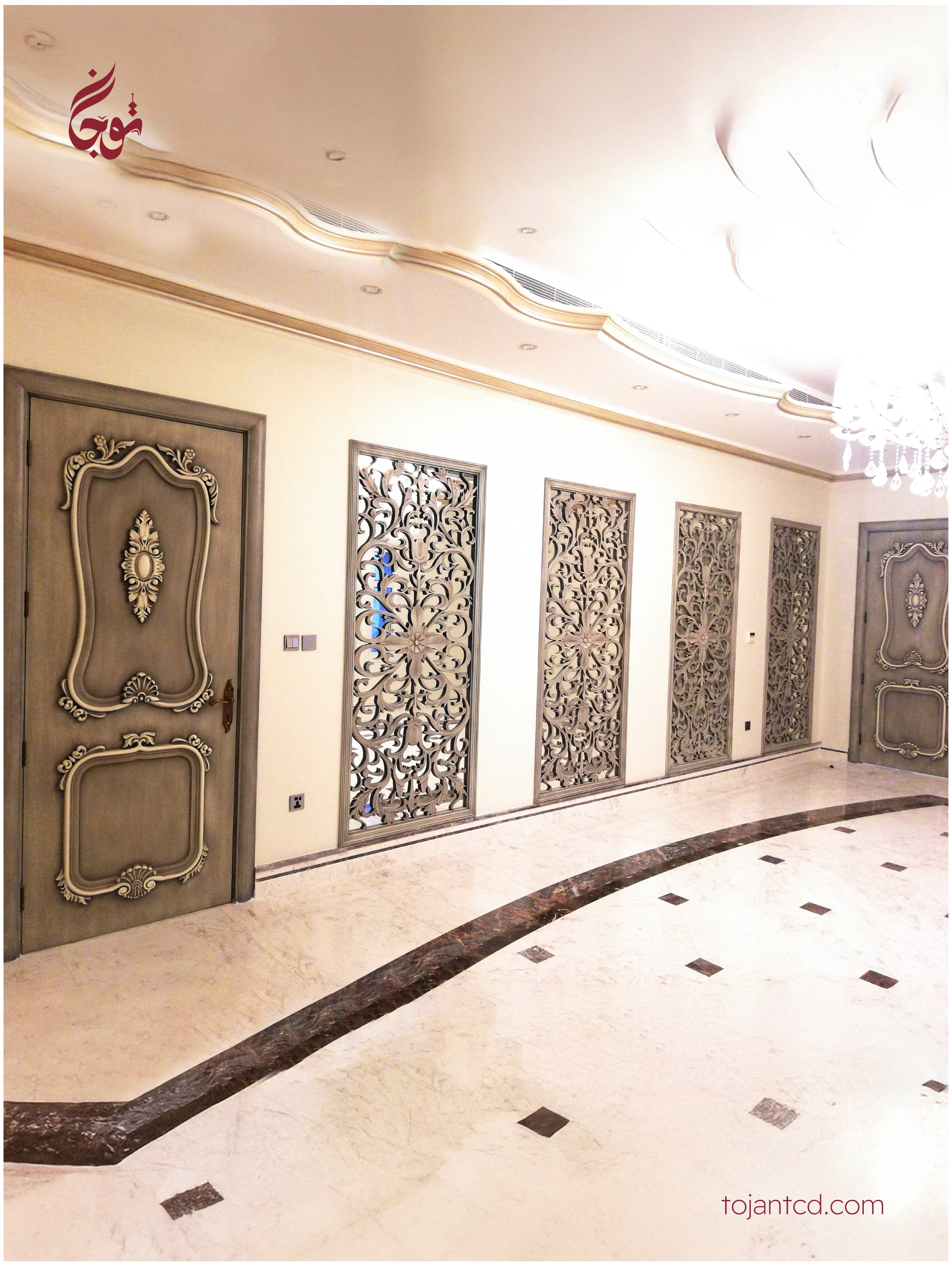
Solid wood is the material people imagine when they picture craftsmanship. It carries depth, weight, and a tactile honesty that no print can replicate, and it can be sanded and refinished repeatedly across decades. For statement entrance doors, a carved majlis feature wall, or a dining table meant to be inherited, nothing else has the same presence.
Its character is also its caution. Solid timber expands and contracts as it gains and loses moisture. In a Gulf villa where guests step from 45-degree humidity into a 22-degree majlis, that movement is real, and a piece built without allowance for it can warp, gap, or split.
- Best for: feature doors, dining tables, bed frames, freestanding furniture, decorative carving.
- Strengths: repairable, ages beautifully, premium feel and resale value.
- Watch for: seasonal movement, higher cost, needs proper acclimatisation and sealing.
Veneer: Real Wood, Engineered Stability
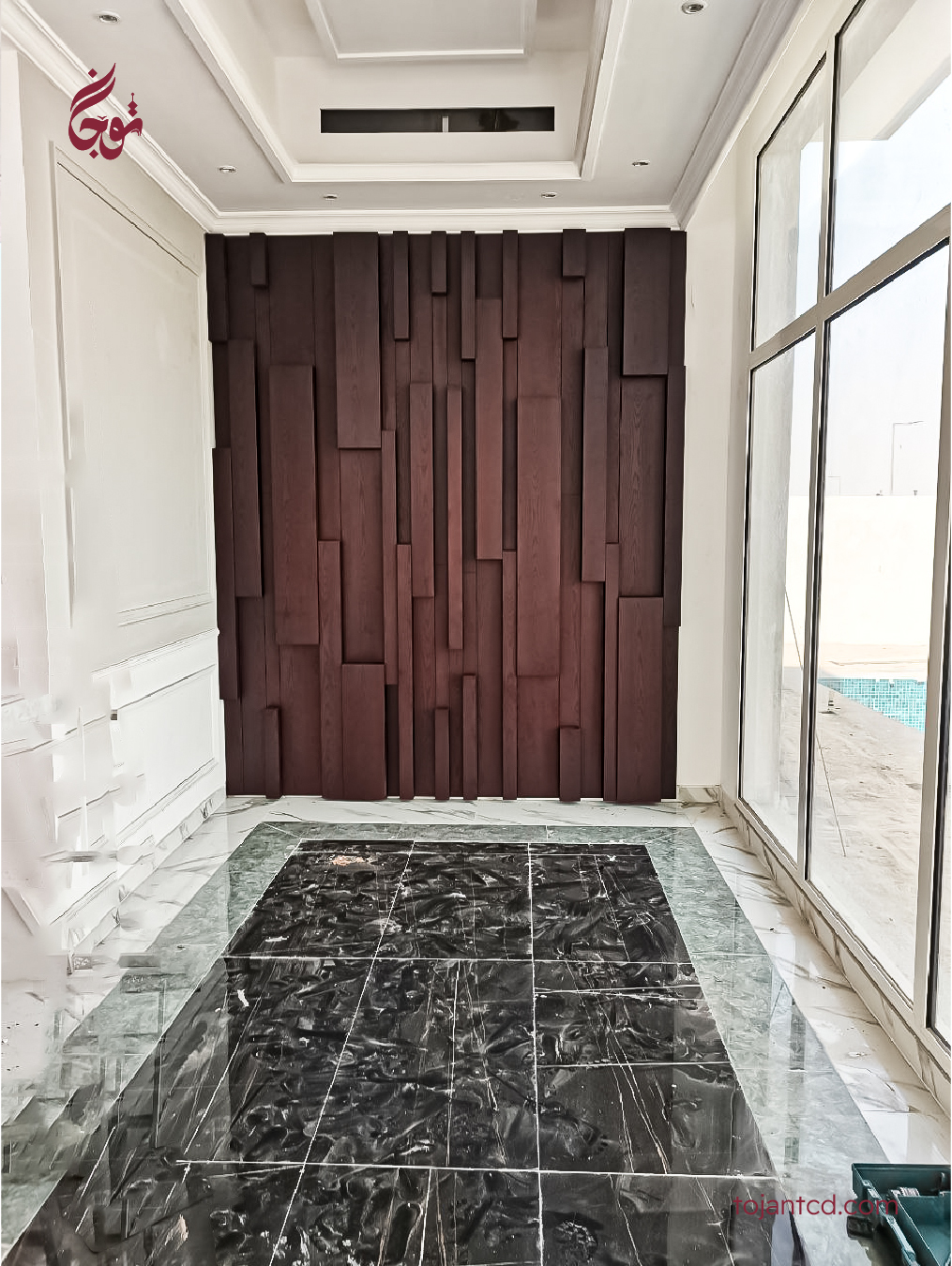
The veneer vs solid wood comparison is where most luxury projects land for large surfaces. Because a veneer is a thin layer of genuine timber over a dimensionally stable core, it gives you the exact grain and tone of walnut or oak while resisting the warping that plagues wide solid panels. It is also how you achieve book-matched grain across a tall wardrobe door or a continuous media wall, which is nearly impossible in solid planks.
Quality varies enormously. A thick, well-bonded veneer over a moisture-resistant core lasts for decades; a cheap paper-thin one over low-grade board can bubble or peel. The skill is in the core selection, the adhesive, and the edge detailing, which is precisely the part a serious workshop controls.
- Specify the species and cut (crown, quarter, or rift) for the grain look you want.
- Insist on a moisture-resistant core for any humid zone.
- Confirm how edges are finished, since exposed veneer edges are the first failure point.
MDF: The Workhorse for Painted Finishes
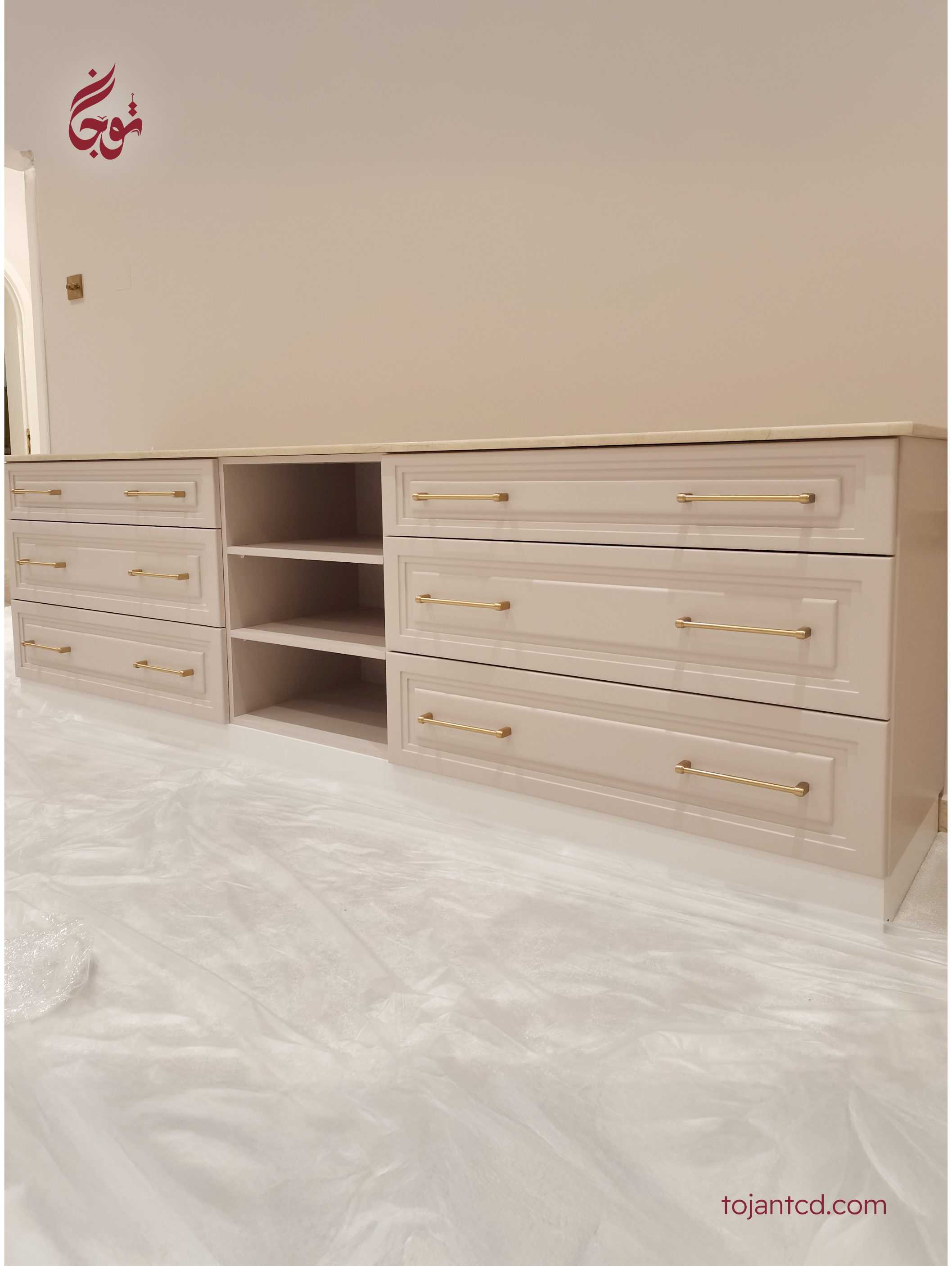
MDF furniture has an unfair reputation built on flat-pack imports, but in bespoke joinery MDF is indispensable. Its uniform, grain-free surface is the best possible base for a flawless lacquer or paint finish, which is why almost every high-gloss white kitchen and crisp matte wardrobe you admire is painted MDF, not solid wood. It also routes cleanly, so intricate shaker panels and grooved profiles come out razor-sharp.
The trade-offs matter. Standard MDF hates standing water and swells if a raw edge stays wet, and it is heavier than it looks. For wet zones we specify moisture-resistant (MR) MDF, often recognised by its green tint, and we seal every cut edge.
- Best for: painted kitchen fronts, wardrobes, wall panelling, decorative mouldings.
- Strengths: dead flat, no grain movement, perfect paint base, cost effective.
- Watch for: water sensitivity at raw edges, weight, not refinishable by sanding.
Solid Wood vs MDF vs Veneer in the Abu Dhabi Climate
This is where local knowledge separates a piece that lasts from one that fails in its second summer. Abu Dhabi presents two opposing stresses: high outdoor humidity, especially in coastal and shoulder seasons, and very dry, heavily air-conditioned interiors. Both extremes pull moisture in and out of wood.
Solid wood reacts most to this swing, so it must be acclimatised in the room before installation and engineered with movement gaps. Engineered wood products, meaning veneer-on-board and MDF, are far more dimensionally stable because the core resists seasonal movement, which is a major reason they dominate fitted kitchens and wardrobes here.
- Coastal villas: favour MR-grade engineered cores; salt-laden humidity is harsh on raw timber.
- Majlis and formal rooms: solid wood feature pieces shine here, since these spaces stay conditioned and stable.
- Kitchens and bathrooms: moisture-resistant MDF or veneered MR board, with sealed edges, every time.
- Around AC vents: avoid wide solid panels directly in the dry airflow, which accelerates shrinkage.
Cost, Lifespan, and Real Value
Price comparisons are misleading unless you weigh lifespan and repairability alongside the upfront figure. Solid wood costs the most but can be refinished for generations. Veneer sits in the premium-to-mid range and delivers a real-wood look at a fraction of solid-wood movement risk. MDF is the most economical and, when painted well, looks every bit as luxurious as the others.
The smartest budgets mix all three: solid wood where it is seen and touched as a statement, veneer across large grained surfaces, and painted MDF for everything that should read as flawless colour. This is exactly how we plan a project so money goes where it shows. If you are weighing made-to-measure against showroom pieces, our guide on bespoke vs off-the-shelf furniture goes deeper.
How to Choose, Room by Room
Rather than picking one material for the whole home, decide per element. A short, practical sequence keeps the decision objective.
- Define exposure: is the piece in a wet, humid, or stable conditioned zone?
- Define finish: do you want visible natural grain (solid or veneer) or smooth colour (painted MDF)?
- Define lifespan: is this a refinishable heirloom or a beautiful 10-to-15-year fitted element?
- Define budget priority: where in the home does spend earn the most visible return?
For inspiration on combining these materials in a single feature, see our ideas on TV units and media walls, where veneer, solid accents, and painted panels often work together in one design.
Frequently asked questions
Is MDF furniture good quality or should I avoid it?
Good-quality MDF in bespoke joinery is excellent, especially for painted kitchens, wardrobes, and panelling, where its flat grain-free surface outperforms solid wood. Avoid only cheap flat-pack MDF with thin coatings and unsealed edges. For wet areas, always specify moisture-resistant MR-grade MDF.
Veneer vs solid wood: which lasts longer in the UAE?
On large panels, good veneer over a stable core often outlasts solid wood here because it resists the warping caused by our humidity-to-AC swings. Solid wood lasts longest where it stays in a stable conditioned room and is built with proper movement allowance, such as a majlis feature or dining table.
Will solid wood doors warp in Abu Dhabi humidity?
They can, if installed without acclimatisation and movement gaps. Properly engineered, sealed, and acclimatised solid doors perform well, but for exterior or coastal exposure we frequently recommend an engineered core with a solid-wood face to balance presence and stability.
Which material is best for a luxury kitchen?
Most luxury kitchens use a combination: moisture-resistant MDF for painted and high-gloss fronts, and veneered board for grained finishes, both over stable cores with fully sealed edges. Solid wood is usually reserved for accents rather than full cabinet runs.
Can I mix materials in one room?
Yes, and the best designs do. A typical Tojan project might pair a solid-wood feature element with veneered tall units and painted MDF cabinetry, so each material does what it does best. Contact us to plan the right mix for your space: get in touch.
Planning a bespoke piece?
Tell us about your space and we'll turn it into something worth keeping.
Request a quote