Wardrobes
Walk-in Wardrobe Ideas for Modern Homes
Tojan TCD7 min read
A walk-in wardrobe is no longer a luxury reserved for the largest villas. In modern Abu Dhabi homes it has become a quiet status piece, a private dressing room that turns the daily routine into something calm and considered. But getting it right in the UAE is about more than open shelving and a feature mirror. Heat, humidity, fine desert dust and long hours of air conditioning all shape what materials last and what layouts make sense. This guide covers practical, expert walk-in wardrobe and dressing room ideas built for the way villas here are actually lived in, drawing on what our joinery team builds every week. For tailored layouts you can also explore our wardrobe and joinery services or browse completed projects.
Start With the Layout, Not the Look
The most beautiful finishes cannot rescue a wardrobe with a bad plan. Before choosing a single handle, map how you move through the space. A good walk-in wardrobe is organised around a clear circulation path, with at least 100 to 110 cm of free floor between facing runs so two people can pass and drawers can open fully. The layout you choose depends almost entirely on the shape of the room.
- Single-wall: ideal for narrow rooms or a converted corridor off the master suite. Everything sits on one run, keeping the opposite wall free for a full-length mirror.
- L-shape: uses a corner efficiently and suits compact villa bedrooms where a separate dressing room is not available.
- U-shape: the classic dressing room layout, wrapping three walls with hanging, drawers and shelving, leaving the centre open for an island or bench.
- Island walk-in: for larger Abu Dhabi villas, a central island adds folded storage, a jewellery drawer and a surface for packing.
Design for the Abu Dhabi Climate
This is where local experience matters most. Imported wardrobe designs assume a temperate climate. Abu Dhabi does not have one. Summer humidity, salty coastal air and the contrast between cold AC interiors and hot exterior walls all create conditions that warp cheap panels and breed mildew on natural fibres. A wardrobe built here should be engineered for it from the start.
- Never place a wardrobe against an un-insulated external wall without a ventilation gap. Condensation forms where cold cabinet backs meet warm masonry, and that moisture sits in the dark and damages clothing.
- Choose moisture-stable cores. High-grade moisture-resistant MDF and marine-grade plywood handle UAE humidity far better than standard chipboard, which swells at the edges over time.
- Keep the AC reaching inside. A sealed, closed-off dressing room with no airflow becomes a humidity trap. Louvred doors, a return-air grille, or simply leaving the room within the cooled envelope keeps air moving.
- Add a small dehumidifier or moisture absorbers in fully enclosed wardrobes, especially for leather goods and wool.
Choose Materials That Last in the UAE
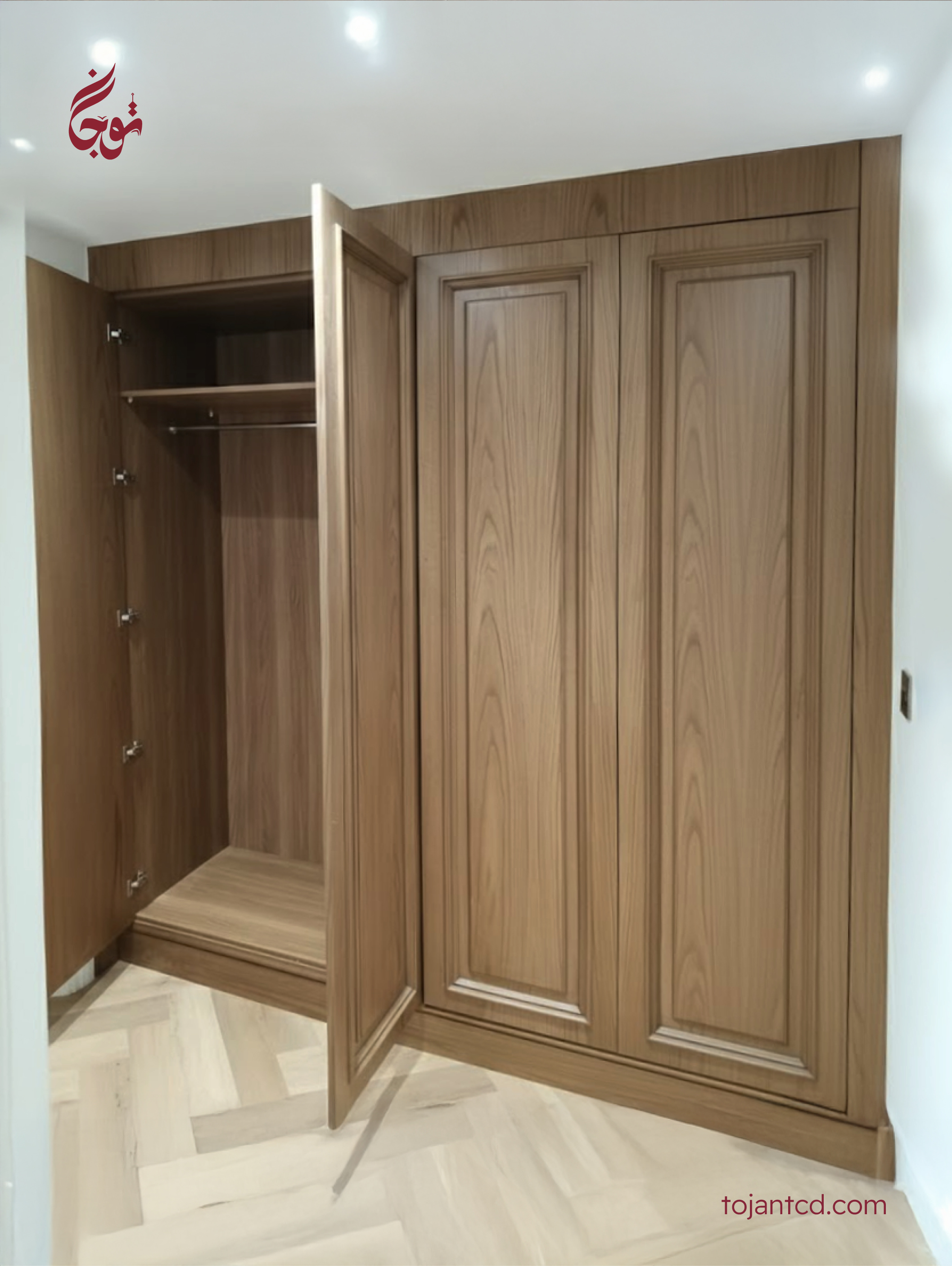
Material choice decides whether a wardrobe still looks crisp after five Abu Dhabi summers or starts peeling at the edges. Solid timber feels luxurious but moves with humidity, so it is best used as accents, frames and doors rather than full carcasses. A durable wardrobe usually combines a stable engineered core with a high-quality surface finish.
For warmth and grain, oak and walnut veneers remain favourites in premium villas, sealed properly to resist moisture. For a contemporary look, matte lacquer and acrylic fronts give a seamless, fingerprint-resistant surface that wipes clean of dust. Backed panels, soft-close hardware and anti-tarnish hanging rails complete a build that ages well. If you want to understand how these choices are made on the workshop floor, our guide on working with a custom joinery workshop walks through the process.
Get the Internal Storage Mix Right
A wardrobe full of long hanging rails wastes huge amounts of vertical space. The secret to a calm dressing room is matching storage types to what you actually own. Audit your clothing first, then divide the space by category.
- Long hanging (dresses, abayas, kanduras, coats): allow 150 to 165 cm of clear height.
- Double hanging (shirts, folded trousers, jackets): two rails stacked, each around 90 to 100 cm, doubles capacity for short items.
- Drawers for folded knitwear, underwear and accessories, with shallow velvet-lined trays for watches and jewellery.
- Adjustable shelving for bags, folded denim and seasonal items up high.
- Pull-out racks for shoes, belts and ties, keeping daily items at eye level.
For households with traditional dress, build dedicated full-length hanging for abayas and kanduras with breathable spacing, since crowded rails crease delicate fabrics.
Light It Like a Boutique
Lighting separates an ordinary closet from a true dressing room. The goal is to see true colour and avoid shadows where you stand. Rely on layers rather than a single ceiling fixture.
- Ambient: recessed ceiling spots on a warm-to-neutral colour temperature around 3000 to 4000 Kelvin for accurate colour matching.
- Task: LED strips under shelves and inside drawers, ideally motion-activated so they switch on as you open them.
- Accent: backlit display niches for handbags or a feature shoe wall turn storage into something showroom-like.
- Mirror lighting: vertical lights either side of a full-length mirror eliminate the harsh downward shadows that ceiling lights cast on the face.
Choose low-heat LED throughout. In a hot climate, traditional bulbs add unwanted warmth to an enclosed space and shorten their own lifespan.
Add Dressing Room Touches That Feel Bespoke
The details are what make a walk-in wardrobe feel personal rather than generic. These are the upgrades that clients in Abu Dhabi villas ask for most once they see them in person.
- A central island with a stone or leather-topped surface for folding and a jewellery drawer beneath.
- A padded bench or upholstered seat for putting on shoes.
- Pull-out valet rods for planning tomorrow's outfit.
- A vanity zone with seated counter, mirror and soft lighting integrated into the run.
- Hidden charging drawers for watches, phones and small electronics.
- Glass-fronted display cabinets for collections, with LED backlighting.
These same joinery principles often extend into matching majlis and bedroom cabinetry, so the home reads as one consistent design language.
Coordinate With Ceilings and Built-ins
A walk-in wardrobe should not feel disconnected from the room around it. In high-ceilinged villas, taking cabinetry to full height removes the dust-collecting gap on top and adds valuable storage. Where ceilings are dropped or detailed, the wardrobe lines should align with them so everything feels intentional. Recessed lighting, cove details and the wardrobe top should share the same plane wherever possible.
If you are renovating the suite as a whole, it is worth coordinating joinery with ceiling work early. Our overview of gypsum ceiling designs in the UAE explains how lighting troughs and cabinetry can be planned together for a seamless result. To discuss a full master-suite fit-out, get in touch with our team.
Plan a Realistic Budget and Timeline
Custom work is an investment, and the smartest clients plan the spend deliberately. A bespoke walk-in wardrobe is priced by the linear metre, the core material, the finish and the complexity of the internals. Spend where it shows and lasts: stable cores, quality soft-close hardware and the finish you touch every day. Save by keeping high, out-of-sight shelving simple.
- Brief and measure: an on-site survey captures exact dimensions, wall conditions and AC layout.
- Design and material selection: drawings, finishes and internal layout are agreed.
- Workshop fabrication: typically three to six weeks depending on scope and finish.
- Installation: on-site fitting, alignment and final adjustments.
A well-built custom wardrobe in Abu Dhabi should serve you for well over a decade, which is why the upfront detail matters far more than chasing the lowest quote.
Frequently asked questions
How much space do I need for a walk-in wardrobe?
A functional single-wall walk-in can work in as little as 1.7 metres of width, leaving room for a run of storage plus a clear walking and dressing path. For a U-shape dressing room with an island, aim for at least 2.7 to 3 metres in width so drawers and doors open without clashing.
Will humidity in Abu Dhabi damage my wardrobe?
It can, if the wardrobe is built from the wrong materials or sealed off from airflow. We use moisture-resistant cores, keep cabinets within the air-conditioned envelope, avoid placing carcasses tight against un-insulated external walls, and recommend dehumidifiers or moisture absorbers for fully enclosed dressing rooms. Built correctly, humidity is not a problem.
What is the difference between a fitted wardrobe and a walk-in wardrobe?
A fitted wardrobe is built into a bedroom wall and accessed from the front, saving space in smaller rooms. A walk-in wardrobe is a separate dressing area you step inside, with storage on multiple walls and room to move and dress. Walk-ins offer more capacity and a more luxurious experience but need a dedicated room or alcove.
How long does a custom walk-in wardrobe take to build?
After the design and finishes are approved, workshop fabrication usually takes three to six weeks depending on the size, the finish and the complexity of the internals. Installation is then completed on site over a few days. We confirm an exact timeline once the survey and design are finalised.
Can you match the wardrobe to the rest of my interior?
Yes. We design wardrobes to share the same timber, finish and detailing as your doors, majlis joinery and other built-ins, so the home reads as one cohesive design. Coordinating cabinetry with ceiling and lighting work early gives the most seamless result.
Planning a bespoke piece?
Tell us about your space and we'll turn it into something worth keeping.
Request a quote