Furniture
Coffee Tables & Side Tables: A Designer's Guide for UAE Homes
Tojan TCD7 min read
A coffee table is the quiet centre of every living room, and a side table is the small piece that punches well above its size. Both are bought on impulse from a showroom more often than any other piece of furniture, and both are the easiest to get wrong in an Abu Dhabi villa where ceilings run tall, sofas run long, and the room often anchors a much wider open-plan space. This guide walks through the choices that separate a forgettable table from one that quietly finishes the room.
Why the "small" tables matter more than buyers think
A coffee table sits at eye level when you are seated, which means its proportions, its top material and its silhouette are read more closely than any other piece in the room. The same is true for side tables next to a sofa or armchair: they live inches from the people using them, and they are touched by every visitor, every day. Choosing them well is less about scale and more about how often they will be seen and used.
The mistake most often made in Abu Dhabi villas is treating these tables as filler. A long sectional sofa anchored by a small, generic coffee table immediately reads as off-balance, and the room never feels resolved no matter how much you spend on the upholstery around it.
Sizing a coffee table to your sofa
Four numbers settle most coffee-table debates. Get them right and the rest is taste.
- Length — roughly two-thirds the length of the sofa, with breathing room on each end.
- Height — within 2 cm of the sofa seat height for comfort and visual balance.
- Distance — keep 35 to 45 cm of walking clearance between the table edge and the sofa front.
- Shape — rectangular for long sofas, round or oval for L-shaped seating, oversized square for deep modular configurations.
For long sectionals common in UAE majlis and family rooms, two smaller coffee tables grouped together often work better than one oversized slab, because they keep proportions human and let you rearrange the room for guests.
Side tables: function before style
A side table has one job: to put a cup, a book or a phone within easy reach of someone seated. Get that wrong and the most beautiful piece becomes useless.
- Height — within 5 cm of the arm height of the chair or sofa it serves.
- Top size — at least 35 by 35 cm so a tea tray sits flat without overhanging.
- Stability — heavy enough that it does not tip when knocked, light enough to move easily for cleaning.
- Hospitality — in majlis seating, side tables earn their place by holding Arabic coffee and dallah, so plan for tray space rather than a single cup.
Pair a sculptural side table with a quieter coffee table, or vice versa, so the eye has somewhere to rest.
Wood species and finishes that hold up in the UAE
The same climate logic that shapes our wider furniture wood choices applies in concentrated form to tables, because their tops collect cups, hands and stray sun in equal measure.
- American walnut and European oak — classic, durable and refinishable for decades.
- Teak — weathers beautifully on covered terraces and in conservatories.
- Engineered substrate with hardwood veneer — dimensionally stable under fluctuating AC, ideal for thin or wide tops.
- PU lacquer finish — forgiving against water rings, easy to wipe clean.
- Penetrating oil finish — ages gracefully and is easy to spot-repair, but rewards consistent coaster use.
For more detail on choosing a top finish, see our companion guide on wood finishes explained.
Style families: from minimalist slab to neo-classic
Style is downstream of the rest of the room, but a useful shorthand for naming what you want.
- Minimalist slab — a single thick wooden top on simple legs, modern and unfussy.
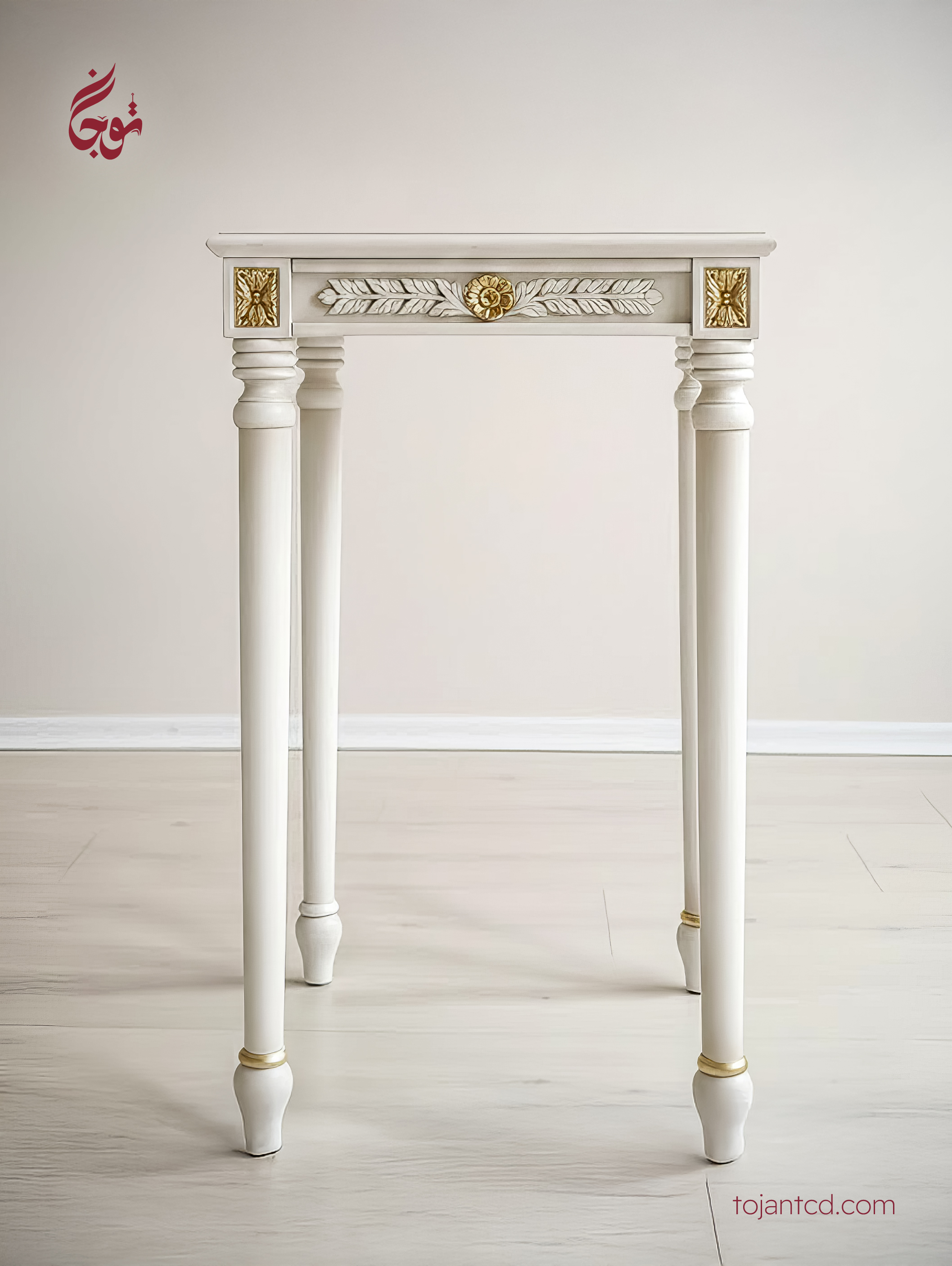
- Neo-classic carved — turned legs, applied mouldings, often in cream and gold for majlis-leaning interiors.
- Brutalist solid — heavy, low, sculpted blocks of solid timber, anchoring loft-style rooms.
- Industrial — metal frame with a reclaimed timber top, best suited to media-room or studio settings.
- Nested or stacked — two or three smaller tables that store under one another and emerge when guests arrive.
Custom vs ready-made: when bespoke pays off
Ready-made tables work when standard dimensions happen to match your space, which is rarer than buyers assume. A custom piece is worth commissioning when:
- Your sofa is a non-standard length or your room is L-shaped.
- The room already has bespoke cabinetry the table needs to match.
- You want the table to share a finish with your wardrobes, TV unit or majlis joinery.
- A specific shape or footprint is needed to navigate around a rug, column or floor pattern.
For a broader view on the value of bespoke, read our piece on bespoke vs off-the-shelf furniture.
Commissioning a custom table, step by step
- Brief and inspiration — gather references and note exactly how the table will be used.
- Site measurement — the surrounding sofa, chair, rug and floor space all influence the dimensions.
- Material and finish — confirm species, edge profile, finish and any carved or inlaid detail with physical samples.
- Approval — a sample finish board and a final dimensional drawing before fabrication begins.
- Fabrication and finishing — built and cured in a controlled workshop, see how this looks behind the scenes in our workshop notes.
- Delivery and placement — tables are placed, levelled and reviewed in situ before sign-off.
You can request a quote at any stage; sharing photographs of the surrounding furniture is the fastest way to get an accurate brief.
Care and longevity
A well-made table should last decades. Light, regular care keeps it looking new.
- Use coasters or a tray for hot and wet items, especially on oil finishes.
- Dust weekly with a soft dry cloth; avoid spray polishes that build up over time and dull the surface.
- For oil-finished tops, reapply a thin coat every twelve to eighteen months in a UAE home with constant AC.
- For lacquer tops, treat scratches early before they collect dirt and become permanent.
Frequently asked questions
What height should my coffee table be relative to my sofa?
Within about 2 cm of the sofa seat height. A noticeably taller table feels crowded against your knees; a much lower one looks unfinished and is harder to reach from a relaxed posture.
How far should the coffee table sit from the sofa edge?
About 35 to 45 cm. Close enough to reach a cup without leaning forward, far enough to walk past the sofa comfortably without brushing the table.
Are nested or stacked side tables a good idea?
Yes, for flexible living rooms. They serve extra guests when needed and tuck back under each other to keep the room visually quiet the rest of the time.
What top material best resists tea and coffee rings?
PU lacquered hardwood and natural stone both perform very well. Oil-finished tops look beautiful and develop character, but they need a consistent coaster habit to avoid water marks.
Is solid wood or veneer better for a coffee table?
In a UAE home with constant AC cycling, a thick hardwood veneer over a stable engineered substrate often outperforms solid timber because the engineered core moves less with humidity swings.
Planning a bespoke piece?
Tell us about your space and we'll turn it into something worth keeping.
Request a quote